Understanding M&A Fees
In the world of mergers and acquisitions (M&A), advisory fees are a crucial part of the transaction process. These fees compensate M&A advisors for their expertise and services in facilitating a successful deal. Two main types of fees are commonly used: engagement/retainer fees and success fees.

Engagement / Retainer Fees
Engagement fees, also known as retainer fees, are upfront payments that provide a steady revenue stream for advisors throughout the transaction process. These fees help advisors mitigate the risk of deals that take a long time to complete or never close. They also ensure that clients are committed to the M&A process.
Engagement fees can be structured in several ways:
Fixed Fee: A one-time payment agreed upon at the start of the engagement.
Monthly Fee: Regular payments made monthly, usually between USD 5,000 and USD 10,000.
Milestone-Based Fees: Payments triggered by specific milestones achieved during the transaction.
Hourly Fees: Fees charged based on the number of hours worked by the advisor.
The choice of engagement fee structure depends on factors such as deal complexity, the advisor’s preferences, and the client’s needs. Fixed or monthly fees are the most common.
Success Fees
Success fees depend on the successful completion of a transaction. These fees are typically a percentage of the deal value and represent the largest portion of an advisor’s revenue in an M&A engagement.
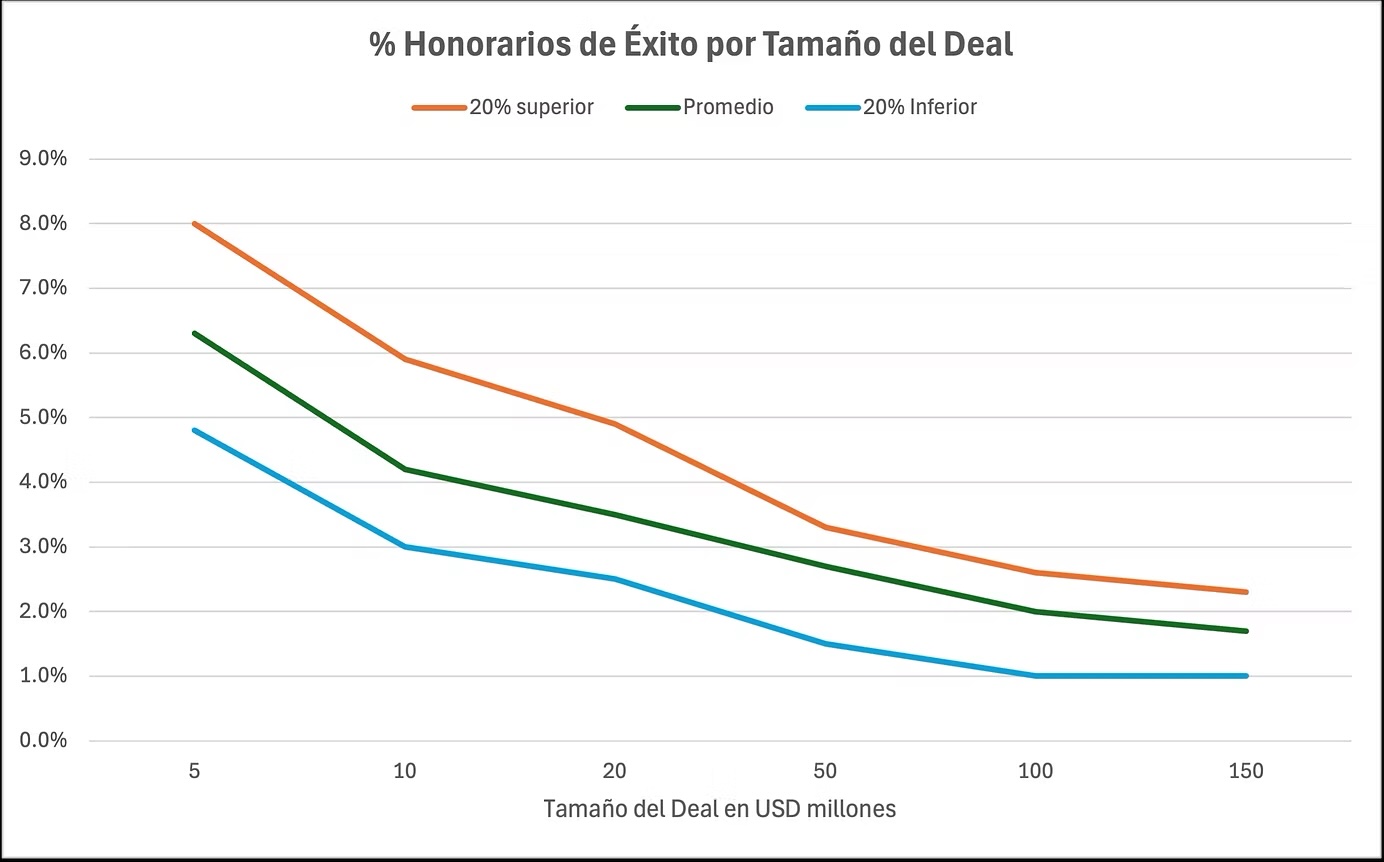
The most common success fee structure is the Lehman Formula, where the commission rate decreases as deal size increases. This structure is designed to incentivize advisors to work on larger deals while ensuring fair compensation for smaller ones.
The following chart shows the results of a survey conducted by Axial.net on the percentage of success fees charged by U.S. M&A firms according to transaction size.
Success fee percentage by deal size
Factors That Influence Fee Structures
Several factors influence specific fee structures and the amounts negotiated between advisors and clients, including:
Deal Size: Larger deals generally have lower success fee percentages, but higher overall compensation.
Deal Complexity: Complex transactions may involve higher fees due to increased time and effort.
Risk: Higher-risk deals may justify higher success fees to compensate for uncertainty around closing.
Competition: Having multiple advisors competing for a mandate can influence fee levels.
Market Conditions: Economic and market conditions can affect the overall fee environment.
General Terms in an M&A Advisory Agreement
These are some additional terms advisors include in an M&A agreement:
72% charge a minimum success fee.
21% charge a fee if their client rejects an offer that meets the originally agreed transaction objectives.
For mid-sized and large deals, engagement/retainer fees are deducted from the success fee.
67% charge the full fee at closing, regardless of when the seller receives the funds. 33% charge as the client receives payments for the company.
Share this article